

A Concept That Surprised Me
When I first heard the term intersubjectivity, I thought it was just another abstract concept, one more idea competing for a place in psychotherapy textbooks. But as I explored it further, I began to see its depth. Intersubjectivity is not just theory. It is an effort to reconnect philosophy and psychology, two “half-brothers” that together help us answer a central question: what makes us human?
A Short Historical Detour
Phenomenology, Husserl wrote, is pure experience, perception without prejudice. Freud, meanwhile, introduced transference to explain the invisible processes happening between patient and therapist, highlighting the impossibility of complete neutrality. Although Husserl and Freud diverged in the early 20th century, later thinkers brought their ideas back together. Kohut, Winnicott, Lacan, Bion, Jessica Benjamin, Ogden, Stolorow and others each added pieces to the puzzle. Their conclusion was strikingly similar:
In therapy, relationship* is the essential factor. (*not in a romantic sense!)
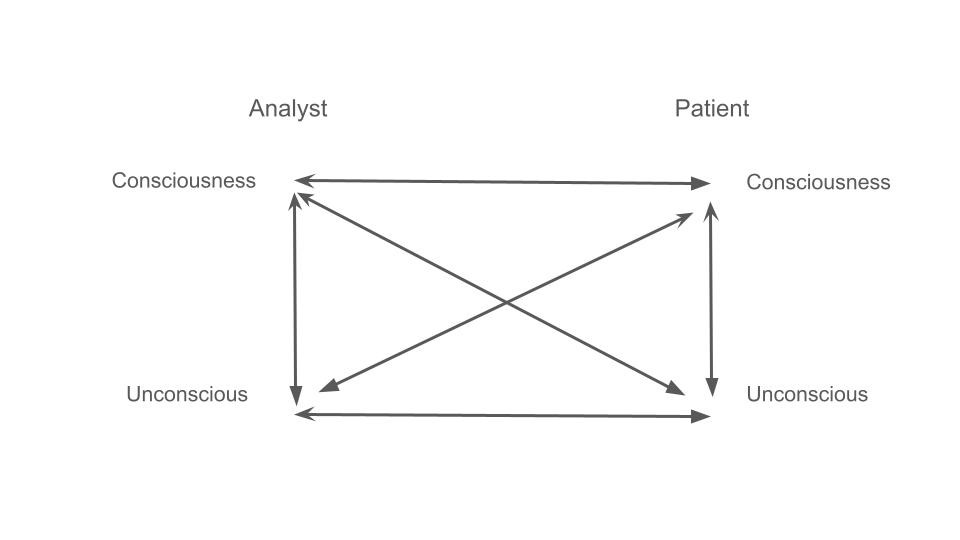
Psychopathology does not arise in isolation, but from experiences of not being in relationship, from a lack of adequate context for one’s inner life. Jung, in The Psychology of Transference, even offered a schema (see below) showing that therapy involves more than just the conscious interaction between patient and therapist.
“You Know What I Mean”
Sometimes people end their short monologue with the sentence above. From a Freudian perspective, this could be seen as an attempt to draw the other person into a romanticized frame. But if we look through the lens of intersubjectivity, we see something else: a struggle to establish a true subject–subject relationship. The first person assumed that the other person must think like her. Even phrases like “this must sound stupid” carries the first signs of change: a tentative effort to imagine herself through the other’s eyes. A small but important step toward a relationship.
Patient, Client… or Something Else?
What do we call the person in therapy? Patient? Client? Neither word is neutral. The patient emphasizes illness and pathology. Clients carry the weight of economics. Partner moves closer to intersubjectivity, but risks blurring the boundaries of the therapeutic setting. Perhaps in the future we will find a better word.
Intersubjectivity in Practice
Therapy is not an equal, reciprocal relationship from the start. Patients rarely meet us as subjects. They often need us first as objects, because in their past, they were objectified by those who should have offered a relationship.
The therapist must accept this role, setting aside their own narcissism, to eventually meet the patient as a subject. Over time, through repeated encounters with reality, the patient learns to perceive experiences more clearly, more “realistically.” But this transformation depends on the therapist too. They must remain open to change and to learning from the client. Otherwise, the risk is what Levinas called totalization: reducing the other to a category, seeing them only as an object in our subjective world.
A Closing Thought
When people ask me about my training as a psychiatrist and jungian analyst, I sometimes joke: “I’ve spent my life studying just to learn how to be quiet.”
The first step is presence. The second is listening.The final step is knowing what, and when to say. From an intersubjective perspective, it all begins with something simple: being truly present for the person across from us.
Isn’t that, after all, the clearest definition of empathy we have?